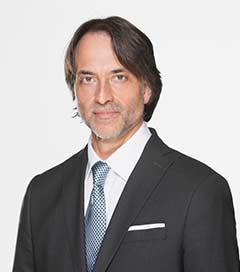
Beyond the Food Fight: Yanni Papanikolaou to Deliver 2026 Gardiner Lecture
Nutrition researcher will explore what large-scale data can—and cannot—tell us about protein, dietary patterns and long-term health
August 18, 2026
Spend enough time reading nutrition headlines and nearly every food eventually becomes either a hero or a villain.
Eggs are in, then out. Carbohydrates are essential, then suspect. Animal and plant proteins are often positioned as competitors, with consumers left to decide which side to take.
Nutrition researcher Yanni Papanikolaou believes the most useful answers are rarely found at either extreme.
“The media has created this war between animal protein and plant protein,” he said. “It causes confusion. It should be about looking at the total dietary pattern and understanding how each food fits into it.”
Papanikolaou will bring that perspective to Kansas State University as the featured speaker for the 2026 Henry C. Gardiner Global Food Systems Lecture. The lecture will begin at 7 p.m. Monday, Oct. 5, in McCain Auditorium. The event is free and open to the public.
His presentation will invite nutrition professionals, researchers, students, agricultural leaders, policymakers and curious consumers into a broader conversation about protein, nutrient adequacy, longevity and the challenge of communicating science in a divided information environment.
At the center of that conversation is a deceptively simple question: What can data tell us about the way people actually eat?
Two Decades of Data
For more than 20 years, Papanikolaou has worked with the National Health and Nutrition Examination Survey, commonly known as NHANES. The national dataset combines information about what Americans eat with health interviews, physical examinations and laboratory measurements.
“The database allows us to ask almost any question, as long as the information was collected,” Papanikolaou said.
Those questions have taken his research across the grocery store and through nearly every stage of life. His published work has examined animal and plant protein, beans, grains, eggs, and even mangos, as well as nutrient intake among children and adults.
That range is important to Papanikolaou, whose work resists the idea that one food or nutrient can explain an entire diet.
His recent protein research offers one example.
Papanikolaou and his collaborators analyzed dietary and mortality data from nearly 16,000 U.S. adults to examine whether usual intake of animal or plant protein was associated with death from all causes, cardiovascular disease or cancer. The researchers found that neither protein source was associated with greater overall or cardiovascular mortality risk.
Because the study was observational, it cannot prove that a particular protein source causes or prevents an outcome. Instead, the findings add another layer to a scientific debate that often reaches the public stripped of context and nuance.
That distinction—between what evidence suggests and what it can definitively prove—is likely to resonate beyond nutrition science.
It shapes how policymakers build recommendations, how agricultural and food organizations communicate scientific findings, and how the next generation of researchers learns to weigh what evidence can and cannot prove.
Papanikolaou’s broader body of work also reflects the complexity of the American diet.
In one study, adults whose dietary patterns included beans had higher diet-quality scores and greater intake of several nutrients that many Americans underconsume. Some bean-eating patterns were also associated with healthier weight-related measures.
His research involving children and adolescents found that certain grain foods contributed meaningfully to fiber, folate, iron and other nutrients, even as public conversations frequently treat grain foods as a single category to embrace or avoid.
Another study found that children who ate eggs had higher intakes of several nutrients, including protein, choline, vitamin D and potassium. The analysis also identified areas in which egg consumers had lower nutrient intake, underscoring the importance of considering the foods that surround any single item within a dietary pattern.
Together, the studies tell a larger story: Nutrition is not a tournament in which one food must lose for another to win.
It is a story about patterns, tradeoffs, access, culture, health needs and the many decisions people make over time.
For Papanikolaou, the research isn’t just academic. Protein has become a genuine personal passion over the past several years—something he says he could talk about for hours—and he plans to weave some of that personal story into the lecture itself.
Trust, Funding and Following the Evidence
Papanikolaou’s work also sits at the intersection of science and industry, where questions of trust, funding and transparency are increasingly important.
He works with food and agricultural organizations to conduct research and translate findings into evidence-based communication. In his interview with K-State, he emphasized that funding sources should be disclosed and that researchers must maintain independence in study design, analysis and interpretation.
He has also seen what happens when results do not produce the outcome a funder hoped to find.
“They may not like it, but that is the result,” he said. “There is nothing you can do to change that.”
That willingness to follow the evidence is part of what makes his lecture relevant to such a broad audience.
A Lecture for Everyone
A dietitian may hear new ways to discuss protein with clients. A faculty researcher may see opportunities for collaboration. A policymaker may consider how scientific uncertainty should be reflected in public guidance. A student may begin to see where a career in nutrition, data analysis, communication or the food industry could lead.
Papanikolaou hopes students, in particular, recognize that research can move far beyond a journal article.
“Students may wonder what their research will do, how it will contribute to public health or whether it will actually make a difference,” he said. “It absolutely can.”
Kansas State University established the Henry C. Gardiner Global Food Systems Lecture Series to provide science-based education about world food issues. The series allows students, faculty, staff and Kansas citizens to interact with U.S. and international food industry leaders on topics of current interest. The lecture series is funded by the Gardiner family of Ashland, Kansas. Henry C. Gardiner, who died just days before the 2015 lecture, was known as a visionary leader who dedicated his career to improving the beef industry through science and technology.
More information about this year's lecture, including videos of past speakers, is available online at https://www.k-state.edu/research/global-food/events/lecture-series/.